Prototype 2020–2025

E-SUP

Detachable electric propulsion kit for inflatable stand-up paddle boards

2 Independent Motors
4 Battery Packs
2 Wireless Controllers
Scroll

What is E-SUP?

E-SUP is a detachable electric propulsion kit designed for standard inflatable stand-up paddle boards.

The system consists of a waterproof control box mounted on top of the SUP and two electric motors integrated into fins mounted underneath the board.

Each motor is powered and controlled independently, allowing differential steering, redundancy, and modular servicing.

There is no need to adjust or change a standard SUP board — the system can be easily installed and removed as a true plug & play solution.

Plug & Play

Install on any standard inflatable SUP board in minutes. No modifications required.

Vision

E-SUP at full throttle on a Swiss lake

Full throttle on a Swiss lake — the E-SUP system powering an inflatable SUP with wireless handheld controllers.

E-SUP at night with LED lighting

Night ride with integrated LED strips illuminating the water — showcasing the system's auxiliary lighting capabilities.

Engineering

System Architecture

4 Battery Packs

Housed in a waterproof enclosure providing reliable power to both motor circuits.

2 Independent Motor Circuits

Left and right motors operate on separate power and control paths for full redundancy.

2 Wireless Controllers

Handheld wireless controllers provide independent throttle for each motor.

Water-Cooled ESCs

Electronic speed controllers actively cooled via closed-loop water circulation.

Modular Mounting

Secured using straps and standard fin rails — fits any inflatable SUP board.

Fully Waterproof

Complete waterproof system architecture with sealed bulkhead connectors throughout.

System Components

Waterproof Enclosure

Houses batteries, ESCs, receivers, and all internal wiring in a sealed environment.

Main Rotary Switches

Individual left/right motor power enable switches for independent control.

Status Displays

System and battery status indication for real-time monitoring.

Voltage Meter

Manual DC voltage monitoring for battery health checks.

Bulkhead Connectors

Waterproof connectors for motor phase outputs and auxiliary connections.

Internal Wiring

High-current XT connectors, fused and strain-relieved for safety and durability.

Electric Motors (2x)

Independent left/right propulsion units providing balanced thrust.

3D-Printed Fin Housings

Structural mount and hydrodynamic element combining function and form.

3-Phase Waterproof Cables

Sealed motor power connections rated for continuous submersion.

ESCs (2x)

Electronic speed controllers with active water cooling for sustained performance.

Water Pump

Active circulation pump driving coolant through the ESC cooling loop.

Silicone Tubes

Closed cooling circuit inside the enclosure for reliable thermal management.

Electrical & Control Architecture

Handheld Controller
Left
Wireless
Receiver
Left
Signal
ESC
Left, Water-Cooled
3-Phase
Motor + Fin
Left
Battery Packs (x4)
Power
Main Switches
L / R
Independent Buses
Power Distribution

Auxiliary Systems

  • Water Pump
  • Displays
  • Voltage Meter
Handheld Controller
Right
Wireless
Receiver
Right
Signal
ESC
Right, Water-Cooled
3-Phase
Motor + Fin
Right

Key Design Characteristics

01

Fully Waterproof Architecture

Every component is sealed and protected. Waterproof bulkhead connectors, sealed enclosures, and strain-relieved wiring ensure reliable operation in aquatic environments.

02

Independent Control & Power Paths

Each motor has its own dedicated power bus, ESC, receiver, and controller. This enables differential steering and ensures the system remains operational even if one side fails.

03

Modular Assembly & Fast Disassembly

The entire system installs and removes without any modifications to the board. Straps, fin rails, and quick-connect plugs make setup and teardown a breeze.

04

Differential Steering

Two fully independent electrical drive systems allow precise directional control by varying the speed of each motor independently.

05

Built-In Redundancy

Single-motor operation is possible if needed. The system is designed so that each side can function autonomously, providing a safety net on the water.

Development Roadmap

The system is functional at prototype level and serves as a foundation for the following development tracks:

Mechanical Refinement

Optimize fin housing geometry, mounting mechanisms, and overall structural integrity for production readiness.

Electrical Simplification

Reduce wiring complexity, consolidate connectors, and improve the power distribution architecture.

Improved Sealing & Manufacturability

Transition from prototype-level waterproofing to production-grade sealing solutions suitable for mass manufacturing.

System Testing & Certification

Conduct comprehensive testing and pursue relevant certifications for market entry.

Supported By

Meet the Team

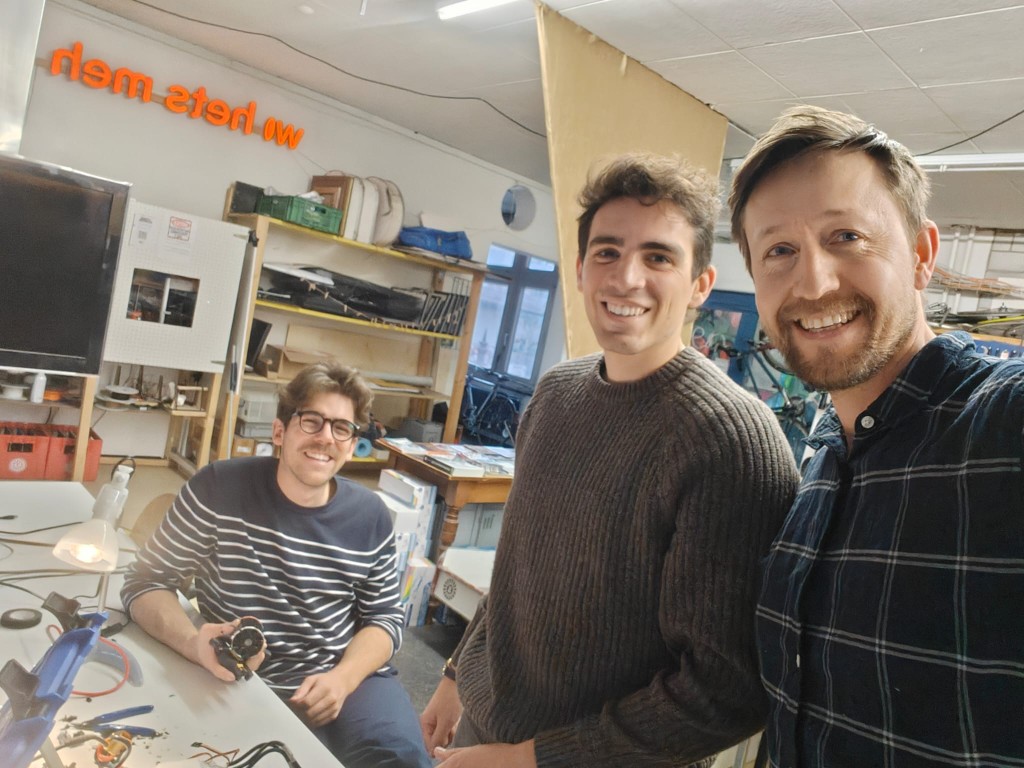
E-SUP team working in the workshop

Oihan, Ernest, and Jacob — the E-SUP team at work in the workshop, prototyping, testing, and iterating on the next generation of electric SUP propulsion.